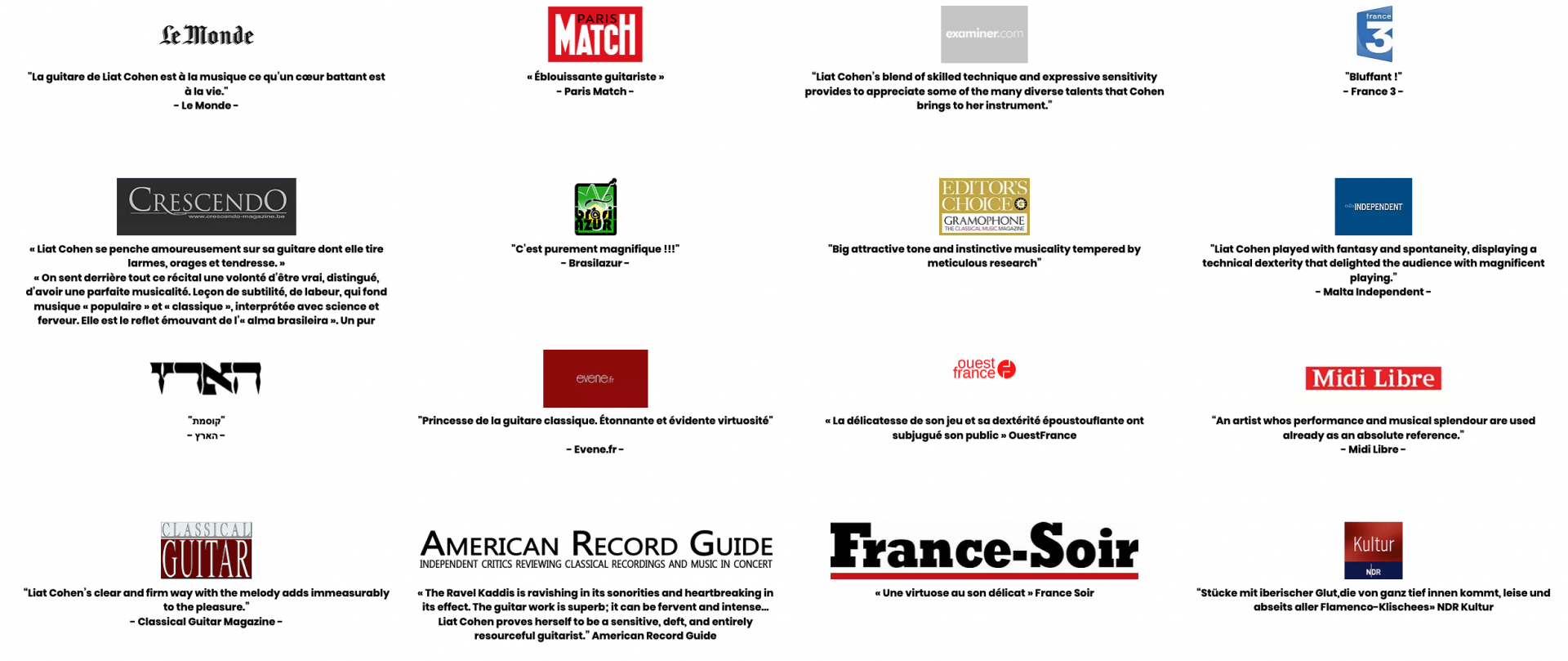
Liat Cohen - Press
PRESENTATION PROGRAMMES RECORDING VIDEOS SCHEDULE

Liat Cohen: “My Jewish culture comes in every colour imaginable”
by Yaël Hirsch, 30 May 2026
From 14 to 29 June, the 21st Festival of Jewish Cultures will be sharing its theme for this year’s edition, “Tempo”, with Parisians. And it is the queen of the classical guitar who will bring the festival to a close on 29 June at the Théâtre de la Ville. Her project is called Les Enfants d’Abraham and lies at the heart of the dialogue between cultures and musical genres. Liat Cohen answers our questions about the time of exile, but also about the time of creation.
Can you tell us about your instrument, the classical guitar?
The classical guitar is the Spanish guitar. But that’s not entirely true, as it has existed for hundreds of years across Europe, particularly in Italy, Portugal (where it’s called the violão), and England since the Elizabethan era. There have been works for lute and baroque guitar since the Renaissance. It is the same instrument with slight variations depending on the country. In the 20th century, the electric guitar arrived with modifications for other musical styles, but it is still the same instrument. With it, I perform a repertoire ranging from the Baroque to the present day.
At the moment, I am on tour in Israel with the Barrocada Ensemble Haifa. But I have also had the chance to premiere numerous works by contemporary composers who write for solo guitar or for guitar and orchestra.
What is the closing programme for the 21st Festival of Jewish Cultures on 29 June?
At the Festival of Jewish Cultures, we will be revisiting the Mediterranean repertoire, ranging from Spanish and Judeo-Spanish melodies in Ladino to South America, notably Argentina and Brazil – countries where the Spanish and Portuguese brought their music, based on this Spanish Baroque music.
I’ve known the musicians accompanying me for a long time: Pierre Baillot plays the oud and also the early flute, and Edmundo Carneiro is a master of Brazilian percussion. And we are fortunate to have the great French baritone Laurent Naouri joining us. It is a programme we had already performed, with a few changes, featuring a soprano, at the 25th Jerusalem Oud Festival in 2024.
The music is partly composed and partly improvised, created on stage from highly complex scores. Each concert is therefore very different.
The festival opens with the Jerusalem Symphony Orchestra. Have you ever had the opportunity to perform with them as a soloist?
Many times. They accompanied my first album, *The Jewish Soul*, 25 years ago, on which we performed four symphonic works for guitar and orchestra, two of which had been composed for me. The album was released by Warner, enabled us to tour together and was even named Classical Album of the Year in the United States. We met up at the Jerusalem Festival, where we premiered some new concertos. This opening concert is going to be absolutely magnificent!
What is your relationship with the Sephardic language and culture?
I grew up in Israel and have lived most of my life in France. My Jewish culture is as diverse as can be, with a classical and European heart. Ladino isn’t part of my roots, but I have a deep cultural and musical interest in it: when I first started working on this repertoire, I collected recordings often made by elderly female singers.
I’ve revisited this popular repertoire with composers who are sometimes French or Israeli, but also Russian, Argentinean and Brazilian. It’s amazing what Ladino and Sephardic culture can offer us today.
The theme of this 21st edition of the festival is ‘Tempo’. What will the tempo of the concert be?
Tempo is at the heart of our concert. We’ll be exploring rhythms and tempos from all over the world: Brazilian rhythms that make it impossible to stay still, but also Argentine, Spanish baroque and contemporary rhythms.
The heart of the concert consists of these rhythms that intertwine and inspire one another. Tempo itself has evolved throughout history. Very ancient rhythms from the Moorish era in Spain, played on the oud, crossed the Atlantic to Latin America. That is why we will start with Ladino songs, before moving on to the Spanish repertoire and then to the Latin American repertoire. In Brazil, African rhythms have been added to the Portuguese influence. All these layers overlap, and it is fascinating to trace the threads of inspiration and the stories that have led to contemporary rhythms.
How do you synchronise the tempos of the oud and the guitar?
Over ten years ago, I formed a trio called ‘Cousins’. It consisted of my contemporary guitar, a flamenco guitar and a Moroccan oud player. We were exploring rhythm and harmonies. On the oud was Nabil Khalidi, a true master.
As we were creating new pieces, I suggested teaching him the European notes quickly. He took offence: “Why do you want me to learn sheet music? Am I a bad musician?”
Ear training and sheet music don’t work in the same way in Eastern and Western music. You have to find a mathematical way to strike a balance between the Western 2/4 time and the more complex cycles of the East.
You’re releasing a new album on 19 June, entitled *Valse* (Indesens Calliope Records), featuring works by Barrios, Piazzolla and Tansman, amongst others. Could you tell us a bit about it?
It’s the first album I’ve released since the war began. It’s a journey around the world through these three time signatures.
The waltz, which has existed since the 17th century, is found in every European country and crossed the Atlantic to Latin America. It’s a solo album (except for a *Libertango* with Edmundo Carneiro) featuring great composers from France, Germany, England, Spain, Russia, Venezuela, Mexico… a repertoire for guitar drawn from the four corners of the world.
This is a lovely response to those who say that the guitar is a Spanish instrument. And it’s beautiful music for dancing, for dreaming, as we head into summer.
The ensemble you’re performing with on 29 June is called ‘Les Enfants d’Abraham’. Like ‘Cousins’, is this also a political statement?
I believe we are all cousins, that is to say, human beings with shared traits. We see this clearly in our music: there are Ladino songs that I know in Hebrew, my colleagues play them in Spanish or Arabic. Andalusian music is our common root.
Just as we can be bound together by history and friendship, by the past, we can do so in the future. What is happening right now is tragic, and I think it is our role as artists—through our music, our writing, our books, our paintings, each through our own channels of expression—to find a way to share our lives. It is crucial. And besides, it’s so beautiful! Why not do it?
You’re currently on tour in Israel. Is cultural life still thriving there, despite everything?
There are very difficult times. We’re in a constant state of war. Flights are often cancelled. Whenever tensions rise, the whole cultural scene grinds to a halt. Yet there is no such thing as ‘intermittent work’ in Israel. Projects we’ve been preparing for months are put on hold. It was the same during Covid. Major Israeli companies have seen many tours cancelled, with reactions that bear no relation to their creative work abroad or in Israel. We are trying to keep our heads above water. In difficult times, we pour our emotions into music and creativity: it is the only way I know to cope with this.
Every household in Israel has been affected by loss and violence since 7 October. Music is essential for surviving these tragic times mentally and psychologically.

Liat Cohen leads a trio in an exceptional concert, 26 May 2026
Leading a trio, this outstanding guitarist, with her subtle style, embraces all forms of musical fusion with beautiful musicality. In her latest work, Liat Cohen invites us on a journey to the East, sprinkled with Brazilian percussion.
In partnership with the Festival of Jewish Cultures, the programme entitled ‘The Children of Abraham’ showcases the great guitar repertoire accompanied by the oud, Indian and Oriental flutes, as well as Brazilian percussion. Advocating for the revival of the classical guitar through contemporary composition, Liat Cohen stands out for her inventive playing style. She was, in fact, the first guitarist to receive the Nadia Boulanger Prize from the Fondation de France. A true virtuoso, she has previously transcribed works by Johann Sebastian Bach for the guitar. For this exceptional concert, she dares to bring together traditional Brazilian percussion and ancient Eastern music. In the main auditorium of the Théâtre de la Ville, her performance promises a moment of grace.
Philippe Deneuve
october 2022
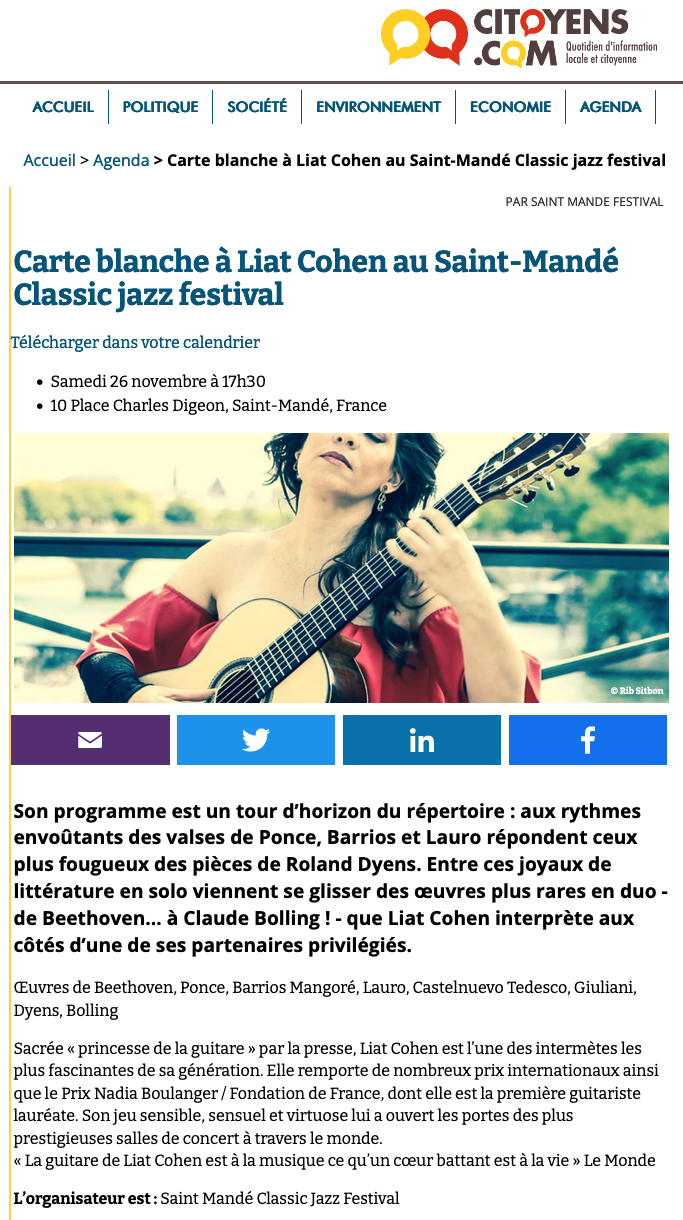
LA DEPECHE - Read
"Pour l’entrée de la guitare dans la programmation, il était important de choisir un joyau mondial", résume Cyril Guillotin. La perle rare porte un nom : la prodige Liat Cohen qui sera ce jour-là l’interprète privilégiée de la musique classique latine.
Magazine L’Art Vues - Read
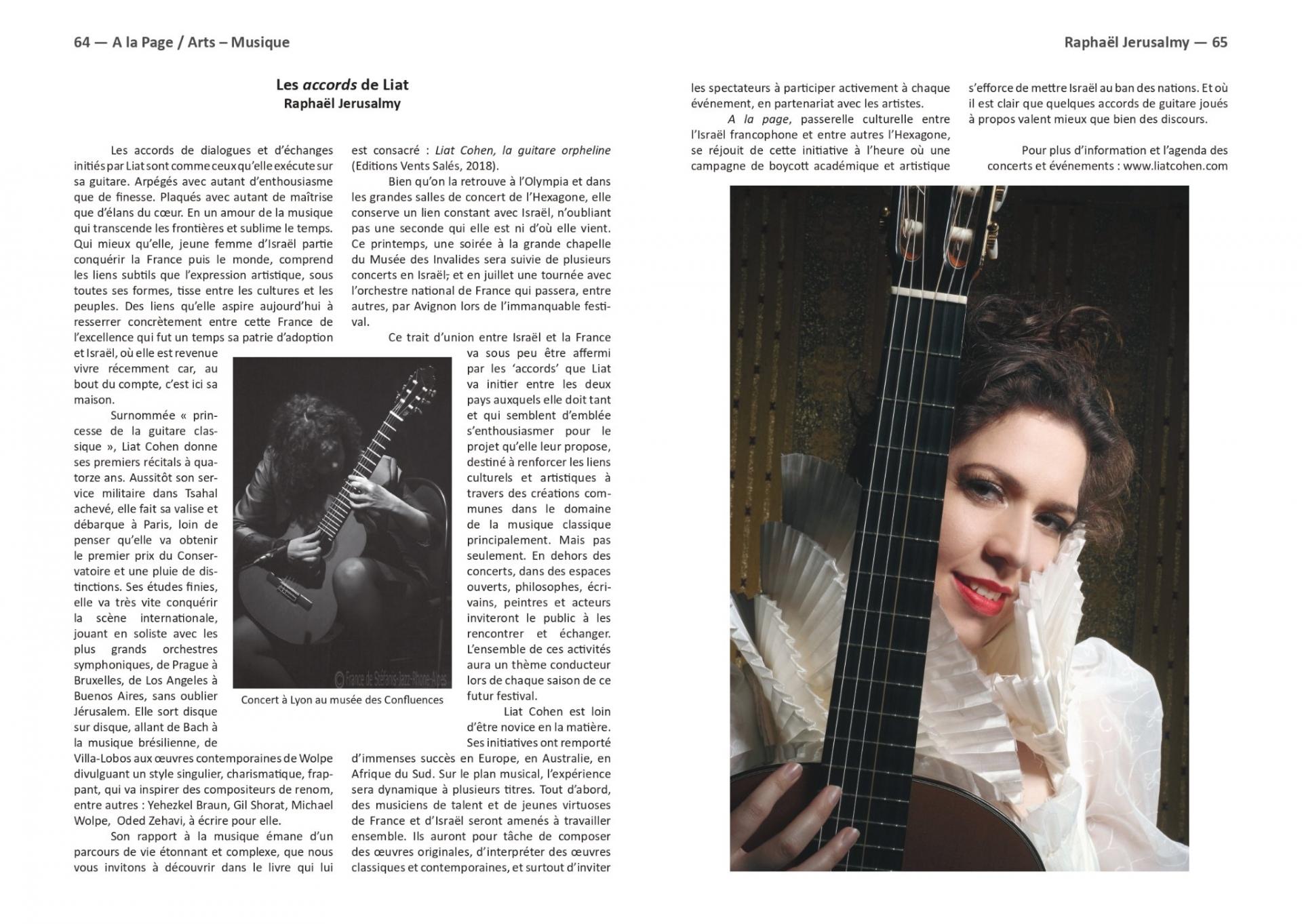
Les accords des dialogues et d’échanges initiés par Liat sont comme ceux qu’elle exécute sur sa guitare. Arpégé avec autant d’enthousiasme que de finesse. Plaqués avec autant de maitrise que d’élan du cœur. En un amour de la musique qui transcende les frontières et sublime le temps.
Journal quotidien d’Israël MAARIV - Read
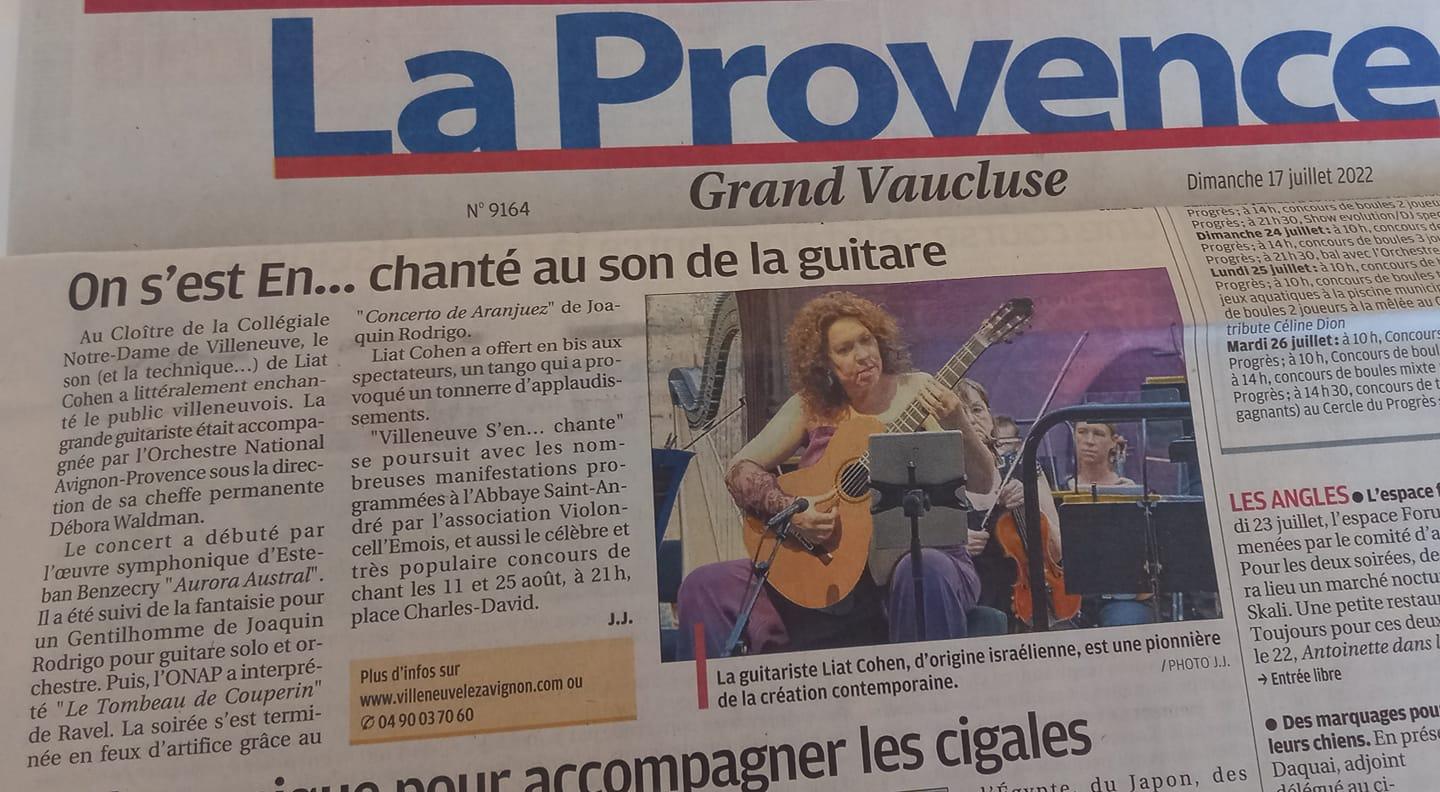
LA PROVENCE
« Le son (et la technique…) de Liat Cohen a littéralement enchanté le public.
Liat Cohen a offert en bis aux spectateurs un tango, qui a provoqué un tonnerre d’applaudissements. »
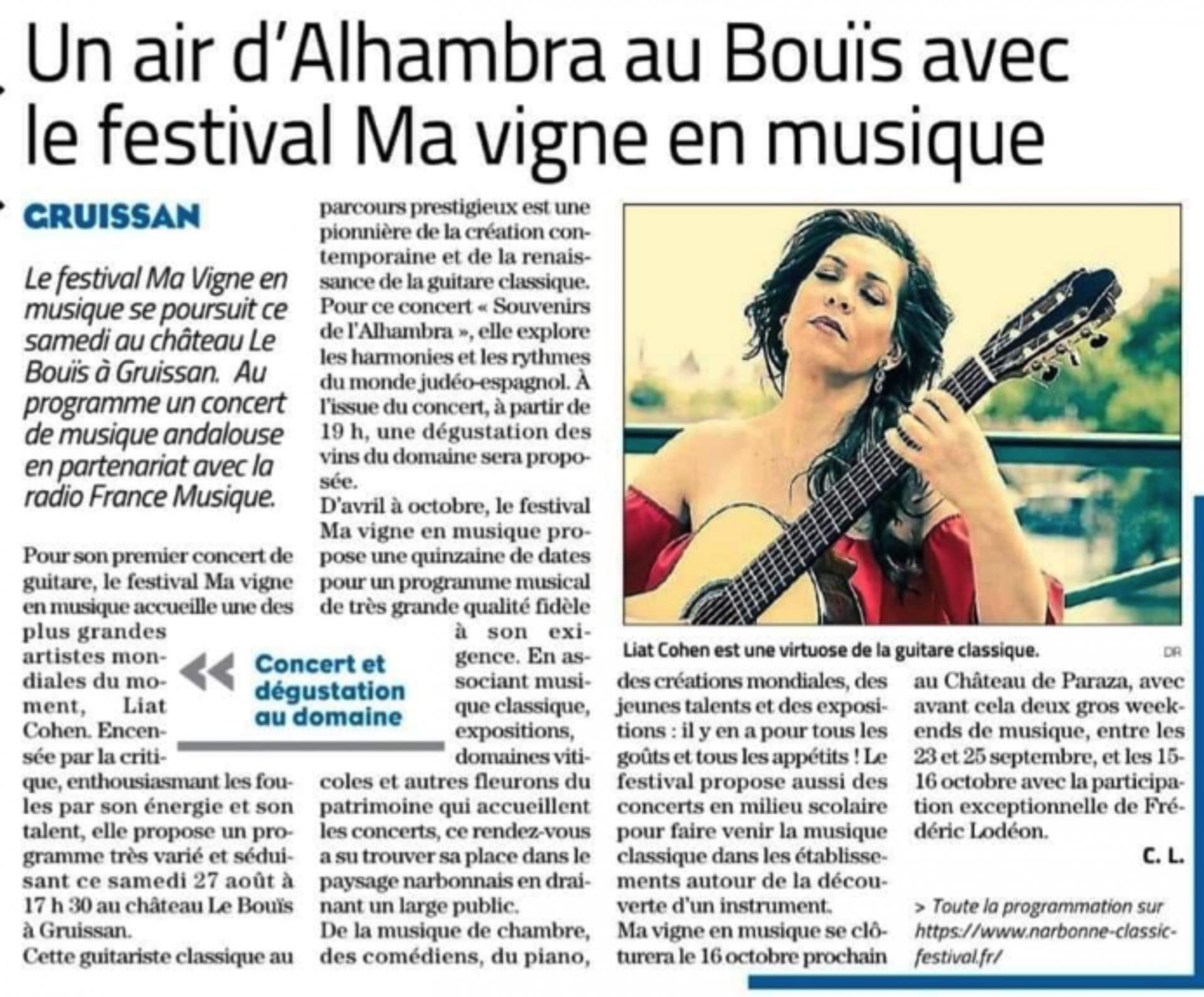
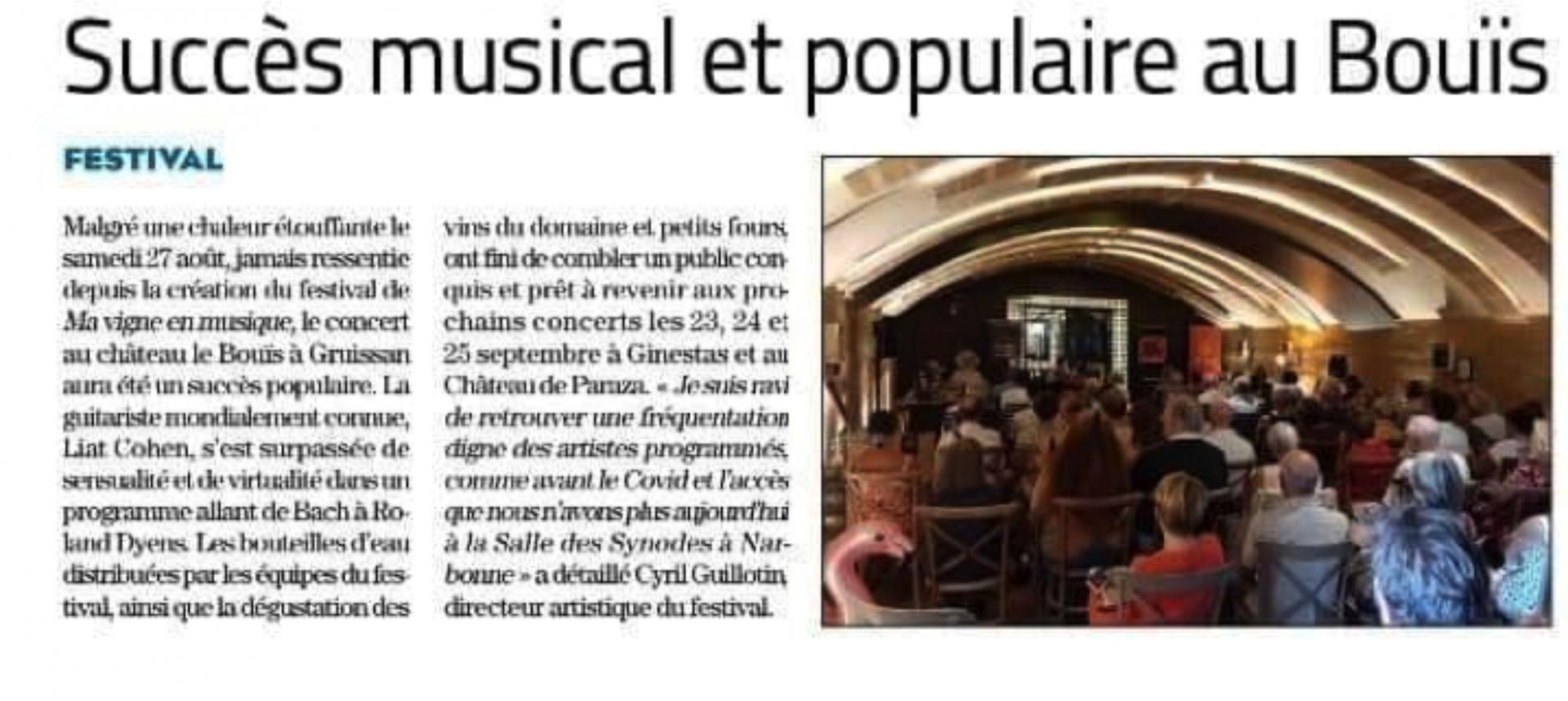
L’INDEPENDANT
« Le concert aura été un succès populaire. La guitariste mondialement connue Liat Cohen, s’est surpassée de sensualité et virtualité dans un programme allant de Bach à Roland Dyens. »
 Orchestre de Paris Sciences et Lettres (PSL), Moati Cohen, Invalides - Jean-Paul Bottemanne - 31 May 2022
The Orchestre de Paris Sciences et Lettres conducted by Johan Farjot and the two soloists, Elsa Moati on violin and Liat Cohen on guitar, delighted a large audience in the Saint-Louis des Invalides cathedral with Camille Saint-Saëns, Ernest Bloch and Joachim Rodrigo and his famous Aranjuez concerto.
They began with Saint-Saëns and his Bacchanale, act 3, scene 3 of the opera Samson et Dalila, a lively and melodious number, offering beautiful instrumental colours, capable of highlighting the PSL orchestra, the vast majority of which is made up of students and staff from several Parisian universities and higher education establishments, proof of its ability to tackle a demanding repertoire with talent and mastery. Here, each line, each section of the orchestra was deployed to achieve the expected dramatic intensity.
Bloch's Trois Images de la Vie Hassidiques gave pride of place to Elsa Moati, a prolific young violinist, renowned and generous in her musical exploration. Gripping and inspired, exuding a vital breath or finally exulting, all the noble richness imagined by Bloch imposed itself with sincerity, suppleness or even gravity under the singing, vibrant and unifying bow of Moati's violin, skilfully supported by Farjot's baton. It was with the same talent and virtuosity that the violinist expressed herself in the Rondo Cariccioso, opus 28 by Saint-Saëns. Here, elegance and grace competed in this nostalgic serenade.
Finally, Liat Cohen and the guitar masterpiece Concerto D'Aranjuez, a composer's nuptial gift to his young wife, with its powerful and intoxicating themes. A demanding score that Cohen has taken on with majesty and brilliance, rendering all the poetic intensity of this unheard-of musical journey with superb skill. This is a masterful achievement by an artist who has been known since her teenage years for the sensuality and delicacy of her playing, with its strong tone. The dialogue between her guitar and the orchestra was lively and calm, skilfully contrasted and complementary.
A beautiful evening for a programme rich in emotion.
 A celebration of music - review
5 avril 2022 - Read
 Gramat. Musicales du Causse : un beau final pour le 25e anniversaire
mercredi 10 novembre 2021, Saint Léon - Read
Gramat. Un beau final pour les Musicales du causse
dimanche 21 novembre 2021 - Read

To close their 2021 season, the Musicales du Causse went a little off the beaten track, rather oriented towards classical music. On Sunday 14th November, they offered a large audience some sunny moments with the guitar of Liat Cohen and the voice of tenor Alvaro Zambrano. The songs smelled of the south and the Mediterranean, such as Joaquin Rodrigo's 'Coplas del pastor', Francisco Tarrega's 'Recuerdos de l'Alhambra' and the popular songs of Manuel de Falla. So much so that the audience would have liked to hear others. "Tonight, thanks to the Musicales du causse de Gramat, we were once again on the verge of the angels. Liat Cohen, in addition to her beauty and her immense talent, graces us with a luminous smile. Thank you for this beautiful complicity and the communicative happiness of the two artists".