Rémi Jousselme & Tristan Manoukian, programmes
PRESS RECORDING VIDEOS PRESENTATION DIARY
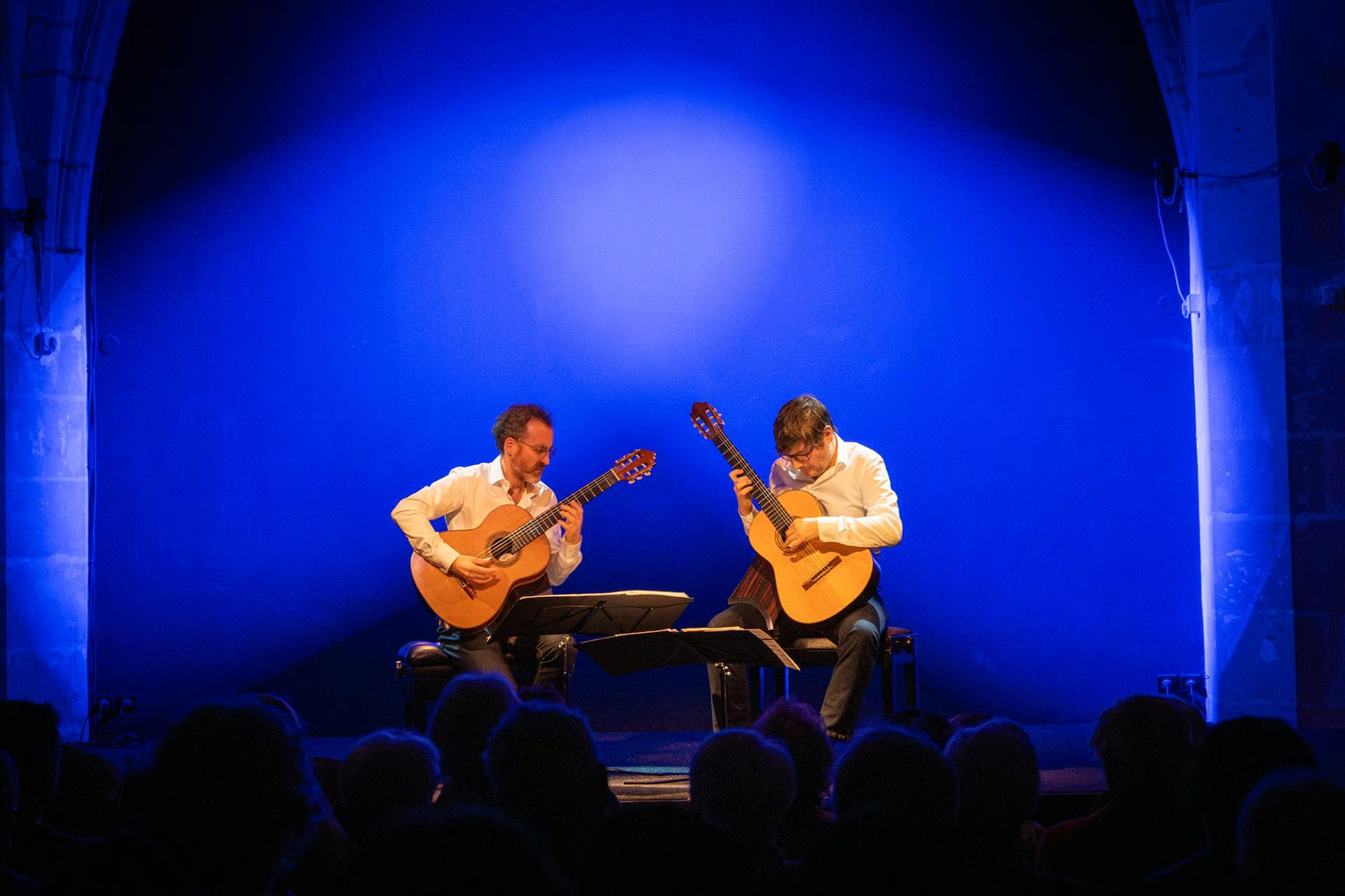
For over twenty years, both as soloists and alongside other musicians, Rémi and Tristan have performed on numerous stages across the globe: Russia, Japan, Korea, Central America, Spain, Italy, Norway, Poland, the United States, and elsewhere. Drawing on all these experiences, in 2020 they decided to form a guitar duo, with the aim of presenting vibrant performances imbued with the energy they hold dear, built around composers chosen for the uniqueness of their musical voice.
Having become friends as teenagers in Catalonia thanks to their shared passion (the irresistible guitar!), they drifted apart as young adults in Paris, only to reunite around ten years ago in Corsica. The joy they derive from combining their sensibilities, experiences and perspectives on the practice and teaching of music drives them to collaborate with increasing regularity. They could not, therefore, resist the chance to savour together the subtle interplay of the guitar duo: this great two-headed lady, with her multiplied possibilities, allows them, through the magic of arrangement, to tackle repertoires previously beyond their reach. To finally play Bartók on the guitar—an old dream come true!
Presentation complete: https://www.bs-artist.com/medias/files/presentation-gb.pdf
The Complete 12 Dances by Enrique Granados
With this new arrangement for two guitars of Enrique Granados’s 12 Spanish Dances, Tristan Manoukian and Rémi Jousselme offer a fresh interpretation of this iconic cycle from the piano repertoire. The decision to retain the original piano keys, a demanding choice from an instrumental perspective, preserves the harmonic richness and distinctive colours of each piece.
The guitar, through its natural connection with Spanish traditions, beautifully highlights the dance rhythms and sublime melodic lines characteristic of Granados’s writing. The dialogue between the two instruments brings clarity and depth, revealing the textures of the work in a fresh light. Striking a balance between fidelity and reinvention, this transcription invites listeners to rediscover these dances through the intimacy and poetry of the guitar duo.
Dance No. 1 Galante / Dance No. 2 Oriental
Dance No. 3 Fandango - Zarabanda / Dance No. 4 Villanesca
Dance No. 5 Andaluza / Dance No. 6 Rondalla Aragonesa
Dance No. 7 Valenciana / Dance No. 8 Sardana asturiana
Dance No. 9 Mazurka romántica / Dance No. 10 Melancólica
Dance No. 11 Zambra / Dance No. 12 Bolero-Arabesca
In a Landscape
The programme revolves around four fascinating figures:
The American Meredith Monk, born in 1942 in New York, is a dancer, choreographer, musician and scriptwriter. She writes minimalist and joyful works, echoed here by the superb and unadorned ‘In a Landscape’ by the revolutionary John Cage, a philosopher and musician who died in New York in 1992, another figure of the avant-garde and a pioneer of experimental music. His emphasis on chance operations, indeterminacy and unconventional instrumentation pushed the boundaries of music.
The Hungarian Béla Bartók also died in New York, having sought refuge there during the Second World War. A true giant of 20th-century music, he tirelessly collected the traditional repertoires of Central Europe. His powerful style, transformed by the rich variety of guitar timbres, is strikingly beautiful.
The ‘Micropiezas’ by the Cuban Leo Brouwer, the programme’s sole original composition for two guitars, with its humour, its allusions to French and Cuban songs, its collages and its polytonality, completes this unique musical landscape—a musical journey through the extraordinary era of artistic creativity that was the 20th century.
Overall, the programme reflects the diversity of musical expressions that emerged during the 20th century, ranging from the experimental and avant-garde to the folk, as well as the global and multicultural influences that shaped music during this period. The juxtaposition of these three figures demonstrates how their unique contributions have had a lasting impact on the development of music in the modern era. By presenting these diverse styles and approaches to music, the programme offers a bold, rich and varied musical experience that reflects the dynamic and transformative nature of music in the 20th century.
Ellis Island by M. MONK 3'
Suite op. 14 by B. BARTOK 10'
In a Landscape by J. CAGE 8'
Micropiezas by Léo Brouwer 7'
Parlour Games by Meredith MONK 8'
6 Bagatelles by B. BARTOK 8'
Folkdance by M. MONK 4'
New York, New York!
Like millions of men and women throughout the 20th century, we arrived in New York via Ellis Island. Musically speaking, of course. For this place name is also the title of an extraordinary piano piece by Meredith Monk, accompanying her film about migrants from all over the world who came to find a new life in the Big Apple. We, in turn, wish to explore this city that has haunted the mythology of the last century through the work of a number of artists who have worked, lived and composed there. Alongside Meredith Monk (born in New York), we will perform music by Béla Bartók (who spent his final years there, refusing to compromise in a Europe under Nazi rule), Chick Corea (who studied in New York and discovered the charm of its jazz clubs), and Astor Piazzolla (who composed there, in memory of his father, a distant farewell — Adios Nonino — as he was unable to return to Argentina due to a lack of funds. Through these major figures, a whole chapter of the music, art and history of the 20th century emerges, a century in which New York was one of the key hubs.
Ellis Island by M. MONK 3'
Suite op. 14 by B. BARTOK 10'
Children’s Song by C. COREA 11'
Decarisimo by A. PIAZZOLLA 3'
Coral by A. PIAZZOLLA 5'
Adios Nonino by A. PIAZZOLLA 5'
Folkdance by M. MONK 4'
Crossings
A crossing is, above all, a long journey across the ocean.
Enrique Granados undertook this journey in 1916, bound for New York, for the premiere of his opera *Goyescas*. The return journey proved fatal for him, in the midst of the world war, and he perished at sea, leaving behind a body of work imbued with a romantic spirit and deeply rooted in his native land, Spain. The six Spanish dances (out of the twelve that exist) in this programme offer a fine selection of his colourful music, featuring moments of profound nostalgia and a contagious joie de vivre.
In a century that saw the proliferation of transport options, Astor Piazzolla undertook a number of journeys, both on land and across the seas. Beginning with that first journey, at the age of three, from Buenos Aires to New York, where he would live until his teenage years. He would return to Argentina, of course, before leaving to study music in Paris with Nadia Boulanger. This ‘tango nuevo’ that he created embodies all these influences: tango, of course, jazz, Baroque music and many other elements that, with his quintet, he would share across the globe, spreading his unparalleled vitality to the four corners of the world.
Through the six arrangements in this concert, we will paint a complex and fascinating portrait of this extraordinary artist.
Of course, a journey is not always, nor is it merely, a movement through space. Without moving a muscle, one can travel far in the imagination and through time. Thus, the meeting of these two musical giants — through the sound of two guitars — will take us to unexpected realms of the senses.
Dance No. 1 Galante / Dance No. 2 Oriental by Enrique GRANADOS
Decarisimo / Coral / Adios Nonio by Astor PIAZZOLLA
Dance No. 5 Andaluza / Dance No. 6 Rondalla Aragonesa by Enrique GRANADOS
Oblivion / Revirado by Astor PIAZZOLLA
Dance No. 10 Melancólica / Dance No. 11 Zambra by Enrique GRANADOS
Libertango by Astor PIAZZOLLA